I've been thinking for some time about stories and fiction and wanted to take some time to express a similar thread I see in most good fiction. Take a few moments to reflect on books or movies that you've read recently that would classify as fiction with a normal protagonist, theme, plot, etc. For some, you may be thinking of Lord of the Rings, Batman, the Lion King, or even 24! One of the similarities I've noticed is the almost laughably predictable climax in these dramas where the protagonist or hero confronts the antagonist and nemesis in the story. You typically find the drama ramp up as the two foes battle and they usually each have blows against each other that wound or hurt their foe. In this way the story expresses the comparable ability of those in the fight and suspends the resolution for a bit longer. In addition to this back and forth, the hero typically is overcome by the antagonist and seems to lose the fight. Take for example Batman's battle with the Joker in The Dark Knight, or Thorin in the last Hobbit movie. For each, the antagonist seems to have the upper hand and the victory, before the protagonist overcomes the odds and the likely ending and wins the confrontation. To use a boxing analogy, it often is as if the protagonist loses the majority of the rounds before connecting on a knockout blow to win the fight.
At times as I've read or watched these depictions I've been annoyed by the predictable scene and the portrayal of the protagonist as being bested before delivering one lucky or skillful blow that defeats the antagonist. Why can't we see a hero who wins quickly or soundly? Why can't the protagonist avoid the near defeat? Now some of this is part of the power of story, of developing drama and tension and pulling at the audience's emotion by increasing that drama or tension, but I think there's more to it.
One of the greatest impacts story can make takes place by developing a protagonist that the audience can identify with. This is done by opening the hero up to reveal their flaws and vulnerabilities. Isn't that what we love about Harry Potter or Frodo Baggins? They seem so ordinary, just like us! The reality is that we each are aware of flaws or vulnerabilities in our own life and long for heroes who overcome those flaws and their foes. That's what draws us to story and ignites our imaginations.
I've recently picked up the Chronicles of Narnia again (first time as an adult) and just finished the Lion, the Witch, and the Wardrobe. It's been years since I last read it, but its funny to read it now as and compare my thoughts and feelings with those I had as a child or teen. One of the things I've noticed is that I've never identified with Peter, the older brother in the story. Something about his character is too right, too good, too absent of flaws. Don't get me wrong, I love Peter, but I've always found commonality with Edmund. Not because I wanted to, but because Edmund is a character that possesses deep flaws; selfishness, and jealousy from the very outset. Those are emotions I could see in myself. One of the aspects of Narnia that I've always appreciated is Edmund's transformation. It's remarkable to watch his change from the petty boy wanting only turkish delight to the king willing to trust Lucy and follow his High King Peter into battle. Edmund's transformation happens not because of something within him, where he became brave and overcame his fear and foes, but it happened because he had an encounter with Aslan. That's ultimately what I love about Narnia or Lord of the Rings for that matter. The heroes don't find the solution to their problems within themselves, but they find it outside of themselves in someone else. Ultimately that's the type of story that I love because it serves as such a clear metaphor to the life we are called to live in Christ. Each of us are filled with flaws, vulnerabilities, and challenges to overcome, but our ability to do so isn't something we can accomplish unless we learn to look to Christ, yielding ourselves to His Spirit, and abiding in Him. In that sense all good stories, that is stories in which we so vividly identify with the protagonist, portray them as not getting out of their circumstances or overcoming their problems through their own wit, skill, or strength, but as they find the True Hero outside of themselves.
For those who might be interested in family, ministerial, or theological observations from my own journey with the Lord.
Thursday, January 8, 2015
Tuesday, December 30, 2014
10 best of 2014
This was the first full year I was able to choose what I wanted to read and didn't have a stack of syllabi that dictated it for me! Needless to say, I took advantage of the freedom. Here were my 10 favorite's of 2014 in no particular order;
Crazy Busy -DeYoung confesses from the outset he's probably the last person that should be writing on this topic, but his own struggles with the issue of busyness allowed the book to come from a perspective of a fellow struggler rather than coming from someone who has the solutions. The chapter on parenting is worth the price and highly convicting.
Lion of War series - A 5-book series that centers on David and his mighty men, Cliff Graham has written the first three (I'm combining the 3 into 1 for the sake of getting them in my top-3 for the year), with two still unwritten. I read the first three quickly as Graham gives great insight into the bonds that build between men as they fight and serve together, while also sticking to the text as much as possible. A great series that makes these characters come to life as you experience their failures, hurts, loss, and their God-given success and victory.
The Great Divorce - C.S. Lewis' classic work on heaven and hell gives us a better glimpse into human nature and the struggles we face with pride and idolatry. One line continues to stick out from this book, "There are two types of people, those who say to God, "thy will be done," and those to whom God says, "thy will be done."" The idea in the book is that perhaps the gates of hell will be locked from the inside out.
Till We have Faces - Another C.S. Lewis class that was said to be one of his favorite books to write. The book takes a look at the story of Cupid and Psyche from Greek mythology with a different perspective. It reminds us of God's use of humility and brokenness in our own lives that brings to a point where we can see ourselves as God does.
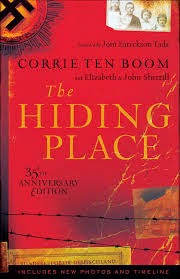
The Hiding Place - This classic by Corrie Ten Boom chronicles the lives of the Ten Boom family in Nazi controlled Holland as they sought to protect Jews from being arrested and sent to concentration camps. Corrie's willingness to admit her own doubts and struggles with faith in the midst of their circumstances not honestly was honest, but allowed her to come across, not as a hero, but as someone we all can empathize with as we see or experience our own trials and seasons of suffering.
How God became King - N.T. Wright's work on the purpose of the Gospels looks at the true meaning of the gospels and their focus, not on Christ's death or resurrection, but the vast majority of them focus on His life. His premise, is that their is something in the life of Jesus that we miss when we as Christians just want to fast forward and talk about Jesus death/resurrection. His belief is that we miss the argument and the identity of Jesus when we skip or hurry through the details of his life as presented in the gospels. Great book.
Counterfeit Gods - Tim Keller's look at idolatry was helpful in thinking about my own struggles with sin, and being able to see patterns of idolatry taking place in the characters of Scripture as well. He argues that all of sin at its core is idolatry and a worship issue. This book was a great resource for self reflection.
Visit the Sick -When I first became a pastor I knew visits were part of the job, but I didn't know what these were supposed to look like. I talked to some pastor friends and got some insight from their experience, but never found a good resource on the subject, until I stumbled upon this book. The book is short, but gives some concrete ideas for what these visits should look like and what the goals should be for the pastor as they take a visit.
Uncommon Union - This history of Dallas Theological Seminary is thorough yet dry, but gives a backdrop into my school that I am appreciative to have read. UU explains so much of what I experienced and why DTS is the way it is. I enjoyed this work and exploring more deeply the roots of my theology and the school where I spent so many years in preparation for ministry.
Heaven I have been wanting to finish Alcorn's book on Heaven for years, but never took the time until now. The book is nearly 500 pages and explores Scriptures teachings on the subject. Nearly any question one might have about the subject is explored and answered. It was a great read that shaped my image of Heaven and excited my imagination about the world to come!
Saturday, August 23, 2014
India Trip
In my experience, trying to boil down a trip of this magnitude, with the miles of travel it took, the opportunities for service, and engagement with cultural diversity always feels like an unfair task. Unfair because I can’t do justice to the incredible brothers and sisters in Christ I was able to serve alongside. Unfair because words on a page can’t properly express the sights, sounds, and smells of a land with such rich cultural and spiritual roots as India. Unfair because the experience of serving in a far off place trimmed down to a few paragraphs of highlights and struggles seems superficial. Since returning, I’ve often been asked, “how was India?” Rather than providing an answer, I would much prefer to answer with a question, “How much do you want to know?”
I write down these observations about our trip, and confess they fall short of expressing the experience, but wanted to pass them along to you, because you should know the needs of our broken and depraved world, and please know India is greatly in need. Secondly, I wanted you to know because I wanted you to be encouraged that prayer was a protection over our team on this trip. So my deepest thanks!
So here are a few observations;
- As I mentioned before, our team (of 6) worked with a ministry called Rahab’s Rope in Goa India. There in Goa, RR partners with two preschools working in two different slums (Think of Slumdog Millionaire) around Goa. The children who attend these schools are coming from Hindu or Muslim homes. At the preschool, the kids learn Bible stories and Christian songs. Families are okay with their kids being exposed to this because of education. Families are so desperate to get a better life for their kids that they don’t mind Christian exposure if the education is strong. As we partnered with the schools, they asked that everything we do connect back to the gospel. Crafts, hygiene programs, or nutrition all was rooted in Scripture.
- Amos talks about a drought in the land of the Word of God. I felt that way about India. In a land with over 1.2 billion people (which you feel the density of the population), the lack of churches is felt. The pastor’s we interacted with were grateful for us being there and asked me to teach at Bible studies and prayer meetings because they longed for the Word of God. Those were my highlights, having the opportunity to teach the Word was a humbling experience I’m grateful to have had.
- We visited two Hindu temples. It was a weighty experience. 2 Corinthians 4:4 rang in my mind. Those who were coming were blinded of the light of the gospel. All we were able to do was pray, that scales and blinders would be removed in the minds of those who came to worship or present offerings to these idols.
- The trash and filth was everywhere. Trash was all over the side of the roads, in fields, and decomposing, which added to the smell. Dogs and cows were everywhere and free to roam where they wanted. On more than one occasion our bus or taxi was forced to come to a stop because cows were in the middle of the road. Sidenote; It added to the chaos that seemed to be the norm in the land.
I got an extra day and flew to Bangalore and saw my good friend Dave Sangiah and his wife Phebey and his young son Arun. The time went too fast, but I loved getting to see them and their ministry. Dave’s been a great friend, and I’ve missed getting to see/talk to him as much now that he is in India. They have a church they are shepherding and Dave is teaching at a local Bible School/Seminary. We had a great Sunday morning of worship at their church. I’m really excited for them and what God has in store for them in Bangalore. Their ministry is providing great Bible teaching and laying a foundation for the gospel throughout India. It would be a great ministry to consider supporting if you are looking at investing overseas.
Finally, let me encourage you to go. Short-term missions certainly have some flaws, but I can't imagine a better way for God to remind my heart of the importance of the Great Commission or the reminder that at the throne we will be surrounded by the redeemed from every tribe, tongue, and nation and the power that the unity we share amidst diversity can have. Take a short trip through your church or a missions agency, you won't regret the experience!
As expressed earlier, I believe in the power of prayer and was indebted to those of you who prayed for our team. Our God is gracious and good and our team is so thankful for your support!
Tuesday, December 3, 2013
Reason for Sports Review
I picked up this book the other night to just get a gist for its flow and purpose and finished it the next night! On the front end, let me admit that I love just about anything Kluck writes (his parts of "Why we love the Church" had me crying in places). He writes with a cynical perspective that blends sarcasm and honesty in a way that I love.
The book is a collection of essays that explore the connections between sports, culture and the Christian faith. From that standpoint the chapters don't build on one another, but in many ways stand on their own. Kluck admits that much of what we see in sports is not admirable, and leaves the Christian to wonder whether we should engage with our culture on this front or not. More than anything Kluck seeks to engage his readers on how Christians should view sports, better said how sports should be funneled through our Christian faith and though the book is not extensive in his exploration of this question, he leaves the reader wanting more, though certainly making one aware of new paths to explore.
His perspective was refreshing in places as he pulled quotes from stars such as Tom Brady and Tony Mandarich, men who are not Christians, who expressed an Ecclesiastes perspective on life, success, and fame. At one point he reminds his readers, "Christian sportswriters can write about non-Christian athletes in a way that still upholds the gospel and makes people think about Christ." Though not expressed, I would think the challenge with this approach is that so few believers see the world through a gospel lens, allowing it to show up in places we rarely would find it. That's where this book was so refreshing, it reminds us that the gospel can be seen even where we least expect it.
Kluck's insights on Mike Tyson and Ricky Williams were needed and should give any fan a warning about cheering or making smug comments at an athlete's demise whether on or off the field. Both of these men are extremely flawed, yet they both express such awareness of their own depravity that never seems to be expressed by a Christian athlete.
Be aware that Kluck comes down pretty strong against so-called Christian athletes, mentioning Dwight Howard as one example of someone who takes the label, but who often fall into very public sin. Kluck seems to suggest he'd rather a Christian not be as public about their faith, but simply be real. I couldn't help but say an "amen" to this point. As a child I read Sports Spectrum and can't tell you the number of guys on the cover who have had very public falls or show character on or off the field that seems contrary to their affirmation that they are a follower of Christ.
In addition, Kluck comes down hard against Christian films and books (I told you some of the sections were random!) Though some of his critique is cinematic in nature, much of what he takes issue with is this cycle that they typically use that shows initial faith, wayward/rebellious years, hitting some form of rock bottom, greater commitment to the Lord, great rewards (new contract, super bowl win). The books continue to be sold, movies made that use that type of cycle. Here's the problem, life doesn't always work out that way and God isn't on the hook if He doesn't provide a super bowl or beautiful wife to the Christian athlete. That's not grace nor the Christian faith. Instead, Kluck points to a movie like Chariots of Fire and displays how the characters are all wrestling with meaning and purpose and seeking to find it in different places.
Finally, Kluck argues that sports are good, but must be compartmentalized, that is that they have a place. Sports are a gateway for men to have relationships. Whether that's at a surface level about fantasy football, a deep and rich level that a father and son find through practices and games, or whether that's a friendship that bridges racial, social, or even religious divides, sports provide that opportunity for guys to engage with other guys. I can't help but agree, my favorite and best moments with my dad are centered around watching, playing, and talking about sports and all the conversations that are spun from those discussions. I've made friendships with guys with whom I shared nothing, but a desire to win or desire to see our team win. This is a great book with a great message for men and the way we view sports.
Tuesday, November 12, 2013
Community Idealism
A few weeks ago our community group added two new couples to our group and so much of the night was built around getting to know each other a bit better. Whenever I start a group I tend to like to go back and study together Acts 2:41-47. It seems to be the small group text! It's beautiful in its description of the early church and the type of oneness and community they experienced shortly after the ascension of Christ. It's always a great starting line for a group to look at the model of community they experienced as they daily met together, met each others needs, shared meals together, and studied and prayed together. In reading the passage, there is something simplistic that goes against what we so often experience today within a culture that exalts the individual to the communities detriment. In that sense every group I've ever been a part of longs to experience what they must have experienced.
Here's the problem with this type of community idealism, it fails to reflect the depths of the text. See here's my confession, I too easily can begin to exalt their example, and fail to think about the burden and challenge it truly would have been. Think about it, have you had a friend ask for money or even a ride before? It's uncomfortable! Meeting the needs of others is always costly, yet they did it. Or how about the fact that they gathered in homes daily across the city. As much as we long for that, there is also a part of us that truly enjoys the drive in the garage and then letting the door down before we step out of our car. We like our isolation! They sacrificed their's to experience the fellowship of the Spirit.
Here's the second problem with this type of idealism, it fails to reflect the movement of the text. In Acts 5 the community experiences problems within, you have people lying to one another in order to gain a profit off of selling their land. In Acts 6 you have some widows that aren't having their needs met. See in order for us to understand the early church, we have to see it in light of the whole picture, both the beauty and selflessness of Acts 2 along with the disfunction and selfishness of Acts 5-6 and when we do we see that the early church was an incomplete picture of community. Incomplete because it had nuggets of what God created us to enjoy, but was marred by our own sin.
Here's why this is important; too often groups read Acts 2 and feel like that's what they need to achieve and six months later when its still tough and you still don't know their kids names' you begin to think, "we're doing it wrong." The truth is it's always been challenging, yet always worth it. So how do we avoid falling into the idealistic trap?
- Be honest about the challenges -Its great to start with Acts 2, but in the discussion talk about the challenges to that picture of community that you will face. It will be hard, it will be difficult, name it on the front end, it sets expectations.
- Embrace the differences- In many respects people often look for similarities with the people in their group, but Paul seems to suggest throughout his writings that there is something powerful about the diversity of the body (see 1 Cor. 12:13), and it reveals a more incredible change than a community that all looks alike.
- Remember the source of unity- Too often people can look for commonalities based on age, affinity, etc. but the early church found that type of unity despite differences because of the unity they found in one Lord and one Spirit. Talk about the source of your unity as a group, so that you can be mindful of Who it is that unites each of you together.
Monday, October 7, 2013
25 Observations of Dallas Seminary
So this has been a long time coming but I'm finally done with seminary. It took eight years, but I finally have the title of Master of Theology, though anyone whose received the degree knows, there is no such thing. I wanted to chronicle 25 observations about my seminary journey in honor of the first assignment you do upon entering the seminary; make 25 observations of Acts 1:8! The observations are in no type of order so please don't see this as a type of ranking.
- International Students- Michael and Jean came from overseas to study at Dallas Seminary. They have every intention of returning and beginning ministries either in their home countries or going to lands that are far less Christian in order to preach the gospel. How sweet it was to share this season of life with diligent brothers in Christ.
- Spiritual Formation Group- The group is a 2-year mandatory small group that students must participate. They tell you horror stories on the front end of leaders that lead like dictators and participants who try to buck the system and end up having to start the group over again. My experience was rich and rewarding, resulting in some of the sweetest friendships from my time in seminary.
- Faculty. I've read that you should pick your seminary based on the faculty and there could be no better advertisement for DTS. Dr. Waters' missionary stories as we studied through Acts, or Dr. Bramer's ability to make the prophets come alive, or Dr. Bingham's innate skill at making all of church history directly relate with issues we face in our churches today are lessons that will continue to impact my ministry. I will also appreciate Dr. Kreider's honesty about doubts, grace, and suffering, and Dr. Coover-Cox's kindness to a poor Hebrew student. These stories and more make my experience rich and sweet.
- Praying as a class on our knees in Hebrew 1 and 2. No doubt DTS is an extremely academic institution, but despite the focus on higher learning, it was a sweet experience to begin this year long study of Hebrew by going to the Lord in prayer on our knees and then end our time together in the same posture, praying to the God who had revealed so much to us through our time together.
- Worship Chapels. Nothing could be sweeter than gathering with others from different nations, all singing and proclaiming songs both new and old in Chafer chapel. Reflecting on chapels of singing those old hymns with Chaplin Bill will excite and invigorate me for years to come.
- WM 101. I took this class the semester that Hudson was born. We'd put him to bed and I'd gently encourage Jen to get to bed early as well so that I could begin my coursework. There were specific lectures from Dr. Young that I watched twice as I was so challenged by his arguments and class. I spent eighteen months wrestling with Matthew 15 before I finally felt like I understood it!
- Going to Israel with Dr. Bramer- Such a wonderful opportunity to get to go to Israel with one of my favorite professors. In addition, I only had to pay $750 for the 10-day tour. God continues to give me insight into His word through that experience.
- Haggai-In all honesty, I had never put much time into studying the minor prophets until I had a research paper on Haggai. At that point I began to see how practical not only Haggai can be, but my eyes were opened to all of the minor prophets.
- Church History- A.K.A. Historical Theology was my favorite area of study. Too often evangelicals seem to lack a connection with the church in past generations and this was something that became obvious in these courses. In many ways it changed my perspective on authority and the role of the church. It also challenged me to read the original writings of those who have gone before. The church fathers, the reformers, and others have steadily been in my reading pile over the last several years.
- Bachelor Weeks- Sangiah's house The first six years of my study were spent doing online and week long courses in the summer or winter. During those week long courses I would usually stay at a friend's, Dave Sangiah's apartment. I'd sleep on his couch, eat out until I ran out of money and then switch to peanut butter. Dave displayed great hospitality and it was always a treat to get that time with him.
- Online Greek 1 and 2- I realize how strange this may sound, and that few would actually believe that I found the online form of the classes more challenging and rewarding than if I had been in the class. Two reasons; first, in order to learn Greek I was completely dependent upon myself. I couldn't lean on a merciful prof or a knowledgeable friend. I had to study and know it for myself. Second, technology can be a gift from above. The websites that coincide with Mounce's textbook as well as some Greek vocab apps made the second semester a joy, and set me on a trajectory to love my studies in Greek.
- God's fingerprints in scheduling- It may have taken me eight years to complete my degree, but I never lived in Dallas, and for seven of those years I had a full-time job. In so many small ways, God's hands were at work in allowing the right courses to become available and for me to get in (even though often wait listed) into the courses I needed at just the right time. The constant answers to prayer always humbled my heart as our Father worked out the finest of details.
- God's provision of funds- Seminary is not cheap, nor do scholarships seem to be available to those who work full-time. Despite the lack of financial assistance from the seminary, I graduated debt free. This is an unimaginable gift and can only be attributed to God's grace and His working on the hearts of generous individuals who invested in my education. I cannot convey my gratitude enough or as deeply as they deserve, but thank you.
- Church Support at Countryside and McKinney- I can't express how gracious these two body of believers have been to me. Early on at Countryside a deacon stood up in a congregational meeting to confirm that the church would pay for my seminary as long as I stayed on staff. Their generosity provided for half of my courses to be covered, more than that their prayers, support, and graciousness with my schedule allowed me to devote time to my studies and improve as a pastor. At McKinney, the constant support, asking questions, and encouraging words kept me going till the end of two years of commuting. These individuals mean more than I could express and my debt to them is greater than they could imagine.
- Taking a course with Jen- It seems ages ago, but prior to kids Jen audited a class with me, historical theology with Dr. Bingham! The conversations that class sparked about life, faith, and culture continue to shape our relationship with one another and our believed role in the church and the community.
- Humility- I was told a story of Haddon Robinson, who would take first year seminary students and tell them, "Many of you think you have all the answers, but you don't even know the questions." In many ways I walked away from seminary more aware of what I don't know and grateful for the insight it provided into those questions rather than just giving supposed answers.
- Camraderie of the preaching classes- Nothing can be more terrifying than standing before strangers and giving a sermon on a proverb. What took place in those semesters was a real bond of friendship, respect, and admiration. Preaching is a very personal act, particularly early on as we are developing security in ourselves and God's ability in us. During the course of those semesters those strangers became co-laborers for the gospel. Watching them develop their skill and the excitement to hear where God leads them is a highlight of this experience.
- Thinking Christianly- This was a favorite phrase of Dr. Bingham and something that I often consider throughout all of life, that my perspective must view each situation through the lens of Scripture, History, and the church. This results in different politics, different educational philosophy, different family dynamics, etc.
- Diversity of DTS The seminary was not just ethnically diverse, but there was a great deal of theological diversity as well. I can remember discussing issues of eternal security with a man who strongly believed a Christian could lose their salvation. I can't say I had ever discussed the issue with someone so versed in Scripture or whose arguments were as theologically sound. We tend to spend time with those who believe just like us, yet the seminary was a terrific place to rub shoulders with other Christ followers who come from different backgrounds or traditions.
- Athanasius I can't say I honestly knew anything of Athanasius prior to attending DTS, but I quickly learned of this hero of the faith and the boldness with which he stood for orthodoxy and the truths of the gospel. I admired him to such an extent that our son Athan is named after him, as it is our prayer that Athan will exhibit such boldness on behalf of the Lord as well.
- Singing in class Early in my DTS days, particularly with Dr. Lightner and Dr. Waters, we would begin each class session with a hymn. I loved and valued this blend of worship with academic study as it set the pace and purpose for the studies we were engaging in.
- Todd 103 Almost every week long and weekend course I took in the early years was in this room. I had my spot on the second to last row right next to the middle column. Terrific insights came in that seat!
- DTS Book Center In terms of bookstores I enjoy visiting, this has to be in my top 3. Something about its architecture (it is a former Orthodox church) and the variety of books on theology, Bible, and practical ministry make this a place I always have to visit when I go back to campus.
- Adoniram Judson Years ago I bought a biography on a number of famous missionaries. I found a 400 page biography on Judson that was said to be the best, though I had no idea when I would sit down to read a biography of such length. For WM101 we were assigned a biography and I figured it was the perfect time to read it and was I glad I did! Judson's hardships and sacrifice for the gospel were awe-inspiring and a continual example I consider.
- Acts 1:8 BE101 was the first class I took and listing observations of Acts 1:8 was the first assignment I had. The verse will forever hold a special place in my heart and draw my attention and focus back to the skills I acquired while at DTS.
- The Words and Works of Jesus Christ If I were to make a list of tough questions or passages from Scripture, at least half of them would be from the gospels. J. Dwight Pentecost's class on the life of Christ and particularly his book entitled "The Words and Works of Jesus Christ" was an invaluable resource as I continue to study and seek to understand our Lord more fully.
- Book of Hebrews I walked away from BE107 concluding that I needed to write an argument paper on every book of the Bible. Not because it was easy, my argument paper on Hebrews was twenty-seven pages and took countless hours, but because of the way I grew from that study and the details about the book that stick with me to this day. "Jesus is a superior person, priest, and has a superior program. As a result we should endure in faith, hope, and love." This statement sums up my outline of the book and reflects an admiration for Jesus I could have only found through the study of Hebrews.
Jay
Monday, September 9, 2013
The importance of memories
I'm the type of person who rarely takes pictures when I travel. During a 10 day trip in Israel I took 200 pictures. There were people in our group who took 10,000! There are two reasons for that, first I'm a pretty pathetic photographer. I'm the guy who gets the moving car in the picture or who finds a way to get the shot of you blinking or looking away. Second, I want to see and experience and make last memories with my own eyes and not see everything through the lens of a camera. Those memories, whether it's the smell of the streets of Jerusalem, the sights of looking over a mountain peak as I rode an elephant in Thailand, or hearing my boys say Dad for the first time or pray to their Heavenly Father are much more significant to me than a photo.
God seems to place a great deal of importance on having his people reflect and remember as well. As I've been reading to I Samuel I came to chapter 12 where Samuel instructs the people to stop and remember the history of their people. Similar commands are given in Joshua 24, Nehemiah 9, and Psalm 78, just to name a few. Those leaders longed that the people would remember what God has done for His people in the past and would remain faithful to Him in the present. Peter and Stephen do something similar in Acts 2 & 7 for the church. As I've considered how regularly this takes place I've wondered why, what does reflection provide for us?
The problem is our world is too rushed to prioritize the discipline of reflection. We have our calendar set with meetings, appointments, activities, and tasks all looking ahead at what's coming up, but seldom do we look back at where we've been and what has already taken place. I think that's a problem I face in my life, and fear that's the case for many within our culture as a whole. I'll write more on this topic in the coming days in trying to find resolutions for how to simplify and gain that time to remember.
God seems to place a great deal of importance on having his people reflect and remember as well. As I've been reading to I Samuel I came to chapter 12 where Samuel instructs the people to stop and remember the history of their people. Similar commands are given in Joshua 24, Nehemiah 9, and Psalm 78, just to name a few. Those leaders longed that the people would remember what God has done for His people in the past and would remain faithful to Him in the present. Peter and Stephen do something similar in Acts 2 & 7 for the church. As I've considered how regularly this takes place I've wondered why, what does reflection provide for us?
- Reminds us of the grandness of the story we find ourselves in. Each Israelite generation needed to remember that God's promises for them went back to Abraham and they played a part in that blessing to all people that was promised to come through Abraham and his descendants.
- Unites our circumstances with the trials previous brothers and sisters overcame. For each of us, we face doubt, hardship, and the temptation to give up or settle for less than what God would have for us. Every believer has faced these opponents. In reflecting, we see that those who have gone before us are not that different from ourselves, they fell to sin, they made mistakes, but they endured the opposition and overcame. We face the same challenge.
- Allows our awe for God's great power and true goodness to grow. If nothing else, reflection should bring our hearts to praise God all the more. Whether we are reflecting upon His power and goodness to others who have gone before, or in reflecting upon His goodness to us in years that have gone by, our adoration of God and the humble posture that creates in our own lives is reason enough to take the time to reflect.
The problem is our world is too rushed to prioritize the discipline of reflection. We have our calendar set with meetings, appointments, activities, and tasks all looking ahead at what's coming up, but seldom do we look back at where we've been and what has already taken place. I think that's a problem I face in my life, and fear that's the case for many within our culture as a whole. I'll write more on this topic in the coming days in trying to find resolutions for how to simplify and gain that time to remember.
Subscribe to:
Posts (Atom)
.jpg)